
Certificate in Ketamine Assisted Psychotherapy
Healing Rooted in Science, Somatics and Ceremony
Embark on a transformative journey with the Voyageur Ketamine Assisted Psychotherapy Certificate Program, a collaboration between Rivus Wellness & Research Institute and Palo Santo Therapy. This program is designed for healthcare professionals—including physicians, psychologists, therapists, and nurses—seeking to integrate KAP into their clinical practice.
The certificate program consists of both the Foundational and Advanced KAP modules, blending online learning, in-person presentations, and hands-on experiential work. Participants will engage in dyad work, group activities, and an immersive retreats to deepen their understanding of KAP’s healing potential.
Foundational KAP Module. The first module covers the science, research, safety, ethics, theoretical foundations of KAP, and much more. During the 4-Day Intensive Retreat, practitioners will have the opportunity to experience their own Ketamine session (with medical approval) and explore therapeutic activities like somatic movement, breathwork, and yoga to enhance integration and understand the physiological role in Ketamine therapy.
Advanced KAP Module. The second module dives deep into dosing strategies—ranging from microdoses to psychedelic doses—and their effects on trauma and mental health. Through three guided Ketamine sessions tailored to individual needs, participants will master the art of dosing for various diagnoses and therapeutic goals.Ketamine can support mental health, interrupt chronic pain patterns and alleviate treatment-resistant depression, but the key to lasting change lies in integration. In the Advanced KAP module, practitioners will refine their skills in utilizing neuroplasticity for profound, long-term healing.
Through this program, practitioners will acquire expertise in
- Understanding the neurobiology of Ketamine, exploring current protocols and emerging research.
- Conducting patient assessments, screening, and creating personalized treatment plans.
- Navigating the dynamics of guiding clients through non-ordinary states of consciousness.
- Implementing therapeutic interventions grounded in somatic, transpersonal, and attachment theories.
- Facilitating integration and post-treatment support for enduring change.
- Addressing ethical and legal considerations associated with KAP.
- Ensuring safe and effective implementation into your practice with ongoing consultation and peer support.
- Forming a relationship with a prescriber for your private practice.
This training is designed to empower clinicians, enabling them to ethically and adeptly integrate this emerging therapeutic modality. By expanding treatment options, it aims to provide valuable support for individuals struggling with treatment-resistant mental health and trauma healing. Have questions or want to learn more? Sign up for one of our scheduled information sessions listed below. Class size is limited. Call Rebecca at (918)549-5019 to reserve your spot.
Certificate Training Dates
FOUNDATIONAL KAP MODULE
Session 1: Online Interactive Webinar, March 28th, 12-4pm
Session 2: Online Interactive Webinar, April 11th, 12-4pm
Session 3: Online Interactive Webinar, April 25th, 12-4pm
4 Day In-Person Intensive: May 7-10th
(including supported Ketamine experiential session)
Session 4: Online Interactive Webinar, May 23rd, 2025,12-3pm
Ongoing KAP Consultation Group (May – November)
*Program includes entry to Open Plains: A Psychedelic Symposium, April 19th, 2025
75+ Clinical Training Hours
_________________
ADVANCED KAP MODULE
3 In-Person Ketamine Experiential and Discussion Sessions
Live Online Integration, Preparation & Discussion Sessions
Ongoing Advanced KAP Consultation Group (October – April, 2026)
Schedule
Session 1: Online Webinar, August 1st, 2025
Session 2: In Person 2 day Experiential, August 8-9th, 2025
Session 3: Online Webinar, August 15th, 2025
Session 4: In Person 1 day Experiential, August 22nd, 2025
Session 5: Online Webinar, August 29th, 2025
Session 6: Online Webinar, September 12th, 2025
Session 7: In Person, 2 day Experiential, September 19-20th, 2025
Session 8: Online Webinar, September 26th, 2025
Session 9: Online Webinar, October 10th, 2025
65+Clinical Training Hours
Certificate Program Fees
$3850 registration deadline of March 15th, 2025 (Foundational Module)
$2650 registration deadline by July 15th, 2025 (Advanced Module)
140+ Hours of CEUs for LPC, LADC, LCSW, LMFT
*Payment plan available through Klarna.
*Price does not include accommodations, if needed.
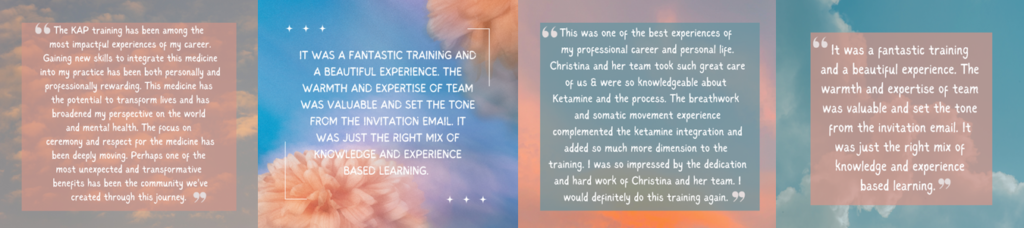
2024 Therapist Cohort Reviews
To Register
Please contact Rebecca to schedule your enrollment screening at:
Clinical Training Team

Christina Conrad, LPCS, SEP
Christina Conrad, LPCS, SEP is a Somatic Psychotherapist and Executive Director of Palo Santo Therapy and Wellness, where she and her team offer Ketamine Assisted Psychotherapy, among other services. Christina is also Lead Trainer and Program Development of Voyageur Psychedelic Therapy Training Program, a collaboration between Rivus Wellness & Research Institute and Palo Santo Therapy. Christina is trained in MDMA-Assisted Psychotherapy from MAPS, Psilocybin Assisted Psychotherapy and offers Psychedelic Integration Therapy and Community Education. With her training as a Somatic Experiencing Practitioner, EMDR and iRest Yoga Nidra teacher, Christina offers a somatic informed Ketamine therapy and training experience.

Dr. Lane Peyton, MD
Dr. Peyton is a board certified psychiatrist and psychotherapist, as well as Executive Director of Rivus Wellness & Research Institute. Dr. Peyton has always been passionate about innovative approaches to mental wellness, which led him to his work with Ketamine Assisted Psychotherapy and Psychedelic Research Studies. Dr. Peyton also founded the Voyageur Psychedelic Therapy and Training Program to bring innovative interventions to the heartland region.

Branda Jean Piersall, RN
Branda Jean Piersall, RN, (she/her) has been an RN for 29 years, primarily in hospice and palliative care.
She is a death doula with certifications in holistic health, nutrition, and spiritual philosophy. She recently
completed the California Institute of Integral Studies (CIIS) Psychedelic-Assisted Therapies and Research
program and is currently pursuing a Masters in Transpersonal Psychology with a focus in Applied
Mentorship. She has also completed advanced training in Ketamine-Assisted Psychotherapy.

Whitney Breshears, LPC, SEP
Live Guest Lectures TBD
Pre-Recorded Guest Lectures By:

Kyle Buller, MS Co-Founder of Psychedelics Today/VP of Training & Education. Kyle earned his B.A. in Transpersonal Psychology from Burlington College, where he focused on studying the healing potential of non-ordinary states of consciousness by exploring shamanism, Reiki, local medicinal plants and plant medicine, Holotropic Breathwork, and psychedelic psychotherapy. Kyle earned his M.S. in clinical mental health counseling with an emphasis in somatic psychology, Kyle also offers psychotherapy services specializing in psychedelic integration, spiritual emergence, and ketamine- assisted.

Angie Leek, LMFT/LPC-S, SEP is a transpersonal and somatic psychotherapist located in Fayetteville, AR. She has a master’s degree in Integral Counseling Psychology from the California Institute of Integral Studies and has completed psychedelic assisted therapy trainings with MAPS, Polaris, Ketamine Training Center and more. Angie is also a core faculty of the VITAL training program through Psychedelics Today, where she also serves on their advisory board. She provides ketamine assisted psychotherapy, as well as psychedelic integration, individual and relationship counseling and clinical supervision through her private practice, Holos Counseling. Angie is also the founder of the Holos Foundation for Transpersonal Healing, a 501c(3) non-profit dedicated to integrating psychedelic assisted therapy into the heartland region of the country as it becomes legally available, supporting therapists training pathways and financial accessibility for all who could benefit from this care.
Program Objectives
Understand the historical context and theoretical foundations of Ketamine Assisted Psychotherapy (KAP), including its evolution, current applications, and potential therapeutic benefits.
Demonstrate knowledge of the pharmacological and neurobiological mechanisms underlying ketamine's effects, including its impact on neuroplasticity. Best Practices for dosing & routes of administration.
Employ effective strategies for conducting patient assessments and screenings, evaluating medical history, mental health status, and risk factors to determine client suitability for KAP.
Integrate somatic, transpersonal and attachment modalities and interventions effectively within the framework of KAP sessions to enhance therapeutic outcomes and support clients through their ketamine experiences.
Understanding the dynamics of ketamine sessions, including set and setting, establishing rapport, guiding clients through non-ordinary states of consciousness, and managing challenging or intense sessions.
Addressing cultural competence, diversity, and inclusivity in providing KAP, respecting diverse belief systems, adapting therapeutic approaches accordingly and the need for greater access to services.
Understand the role of practitioner care and unique transference and countertransference dynamics that can arise in medicine-assisted psychotherapy.
Identify potential risks associated with KAP and develop safety protocols, emergency procedures, and risk mitigation strategies to ensure the well-being and safety of clients during and after sessions.
Engage fully in the process through a supported Ketamine experience, contingent upon individual medical approval.
Implement post-session integration strategies and follow-up support to help clients assimilate and integrate their ketamine experiences into their ongoing therapeutic journey.
Analyze and adhere to ethical guidelines, legal frameworks, confidentiality, and informed consent requirements specific to administering KAP, ensuring ethical and responsible practice.
Recognize the importance of and opportunities for clinical supervision, consultation, and ongoing professional development in KAP practice, fostering personal growth, ethical competence, and best practices in the field.